Setting Up a Turntable Properly – Vibration, Surface, Location
Why Placement Matters So Much
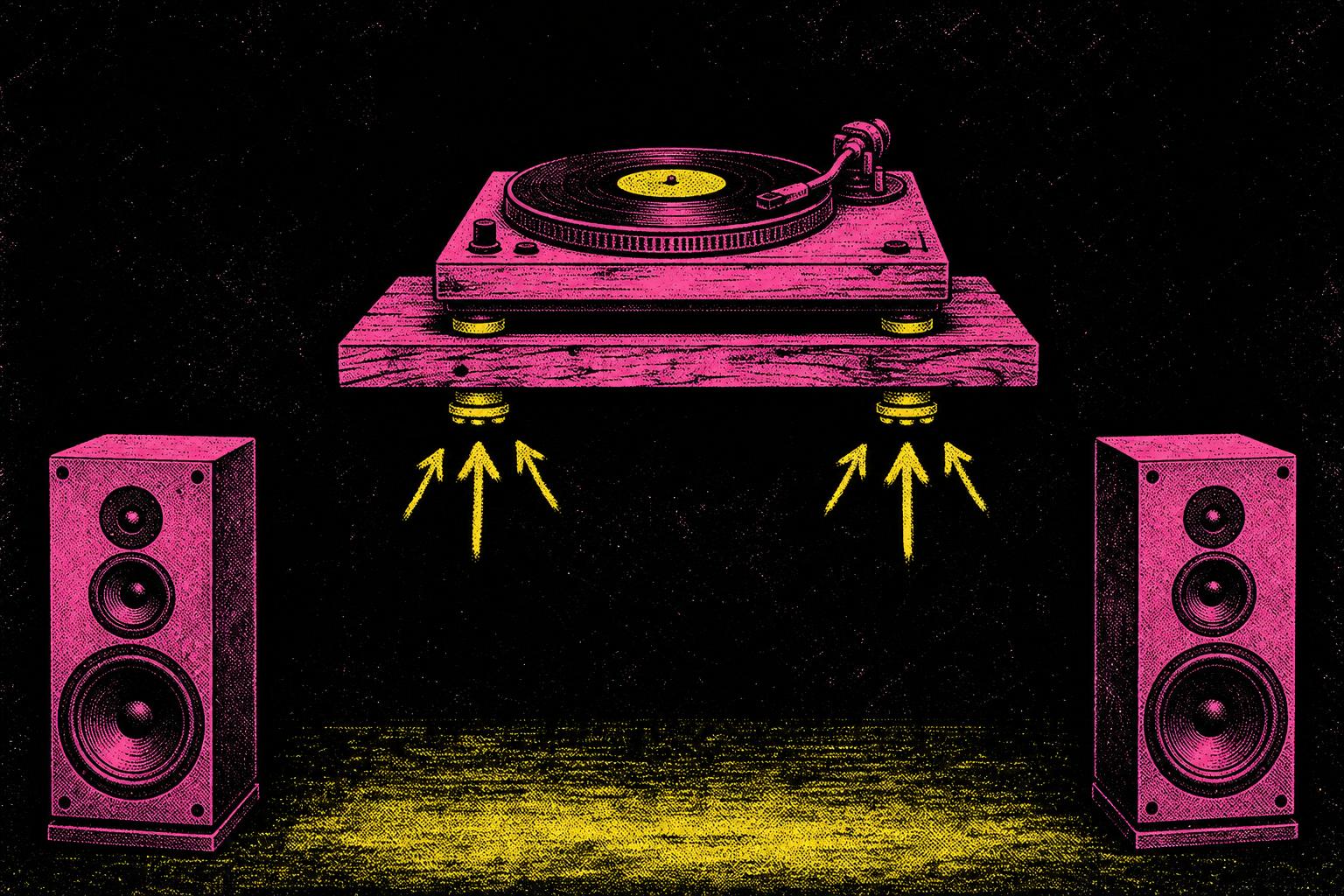
A turntable is essentially a microphone that picks up vibrations – except the vibrations should come from the record grooves, not from the floor, wall, or your own speakers. Poorly placed, even a Rega Planar 6 sounds thin, muddy, and imprecise. Well placed, even a Pro-Ject E1 sounds surprisingly grown-up.
This guide covers the five placement factors that really matter.
Factor 1: The Surface
The surface is the most important decision. Order from bad to good:
- ❌ Floating shelf on the wall with speakers – every bass note jumps into the stylus
- ❌ Plastic or metal TV furniture – resonates along
- ❌ Wobbly side table – every shake transfers
- ⚠️ Solid wood sideboard – okay, but resonances possible
- ✅ Wall shelf with solid wood console on a load-bearing wall – very good, decoupled from floor
- ✅ Hi-Fi rack with decoupled tiers and spike feet – audiophile standard
- ✅ Dedicated solid stone slab (granite, slate) on sand bed – ultimate
Why the Wall Variant Is So Good
Speakers transmit bass through the floor – the floor sets ceilings vibrating. A wall-mounted console decouples the turntable from the floor wave effect. Important: only on solid/load-bearing walls, not on drywall!
Surface Test
While a record plays, knock once firmly with your knuckle on the furniture or floor. Hear a dull thud through the speakers? Then the placement is too close to the speaker or insufficiently decoupled.
Factor 2: Distance to the Speakers
Speakers are the largest acoustic vibration source in any Hi-Fi setup. Rule of thumb:
- Floorstanders: at least 1.5 meters distance to turntable
- Bookshelf speakers: at least 1 meter
- Never place the turntable between the two speakers ("acoustic focal point")
- Never directly on the same furniture as a speaker
Better placement:
- Turntable offset to the side of the speaker triangle
- On a different wall than the speakers
- On its own decoupled platform if that's not possible
Factor 3: Level It Properly
A tilted turntable distorts all cartridge alignment:
- Tracking force is no longer correct (gravity acts at an angle)
- Anti-skating becomes uneven
- Tonearm is loaded one-sidedly
How to:
- Place spirit level on the platter (NOT on the chassis – chassis can be warped)
- Check both axes – once lengthwise, once crosswise
- Adjust furniture feet if needed
- For turntables with their own adjustable feet (e.g. Pro-Ject X1, Rega Planar 3): after furniture leveling, fine-tune the turntable feet
Important: for platter-weight turntables, remove counterweight before adjusting, otherwise tonearm damage.
Factor 4: External Vibration Protection
Floor Waves
On wooden floorboards and bouncy ceilings, every step transmits vibration. Solutions:
- Wall console (see above)
- Heavy stone slab as base (granite, at least 5 cm thick)
- DIY sand box: wooden box filled with fine quartz sand, slab on top – stunningly effective
- Spike feet decouple downward, Sorbothane/rubber feet dampen vertically
High-Frequency Vibrations
Fan equipment (receivers, subwoofer modules) nearby = microscopic vibrations that "smear" the stereo image. Create distance or decouple.
Doors and Movement
For a turntable in the living room: not directly next to a frequently used door. Door slams create pressure waves that can set the tonearm vibrating.
Factor 5: Environment – Light, Heat, Dust
Direct Sunlight
- Warps the cover and the record itself
- Bleaches the cartridge material over years
- Heats the chassis – some belts go soft
Proximity to Heaters
- At least 50 cm distance to the nearest heater
- Direct heater air can deform belts and damage record material
Dust
A removable or hinged acrylic dust cover is mandatory. For turntables without a cover: lay a cover on after each session (cloth or antistatic cover).
Concrete Example Setup
Here's a realistic living room setup for a Pro-Ject Debut Carbon Evo (€1,000 class):
- Location: wall shelf on inner wall, opposite the sofa
- Surface: 4 cm solid MDF board on steel wall consoles
- Decoupling: 4 Sorbothane half-spheres (€1 each) between board and turntable
- Speakers: floorstanders 2 m away, slightly offset to the side
- Light protection: no direct sun; acrylic cover closed at night
Sound gain over "speaker sideboard near turntable": surprisingly large. Bass becomes more controlled, stereo image more stable, micro-details emerge.
Common Mistakes
- Turntable on same furniture as speakers → bass resonance pumps the stylus
- Floating shelf on thin wall → every movement in the room vibrates along
- Tilted surface → alignment off, one-sided record wear
- Table directly in front of bedroom door → door slam jumps the stylus
- Turntable on the TV cabinet above the subwoofer → complete sound killer
When Nothing Helps: Pro Solutions
- Active decoupling (Townshend Audio Seismic Pods, from €250) – spring-based, work in all axes
- Massive isolated sub-platform (Symposium Acoustics, Solidsteel) – from €200
- Wall-mount stand (Solidsteel WS-5) – combines wall decoupling with Hi-Fi look
For 90% of turntables up to €1,500, however, wall console + Sorbothane feet is enough.
Turntable in a Bookshelf? Myth Check
Yes, it works – but not above or next to the speakers, and the shelf must be solid. A typical IKEA Billy vibrates along. A solid oak shelf on a load-bearing wall: no problem.
Related
- Turntable level but stylus tired? Cartridge alignment guide
- Collection grown valuable? Get a record valuation
- Want more vinyl? Buy records & turntables in our shop
- Getting rid of a collection? Sell records & request an offer
- Based in Munich? Record buy-in Munich – on-site & personal
Conclusion
Placement is the area where you get the biggest sound gain for minimal money. €50 for Sorbothane feet and a solid board often brings more than a €200 cartridge upgrade. Only once placement is right do high-end components pay off.
Planning your living room setup or hearing something odd? Visit Second Music & Fun in Munich. We show you various placement solutions on-site and advise on wall consoles, decoupling feet, and surface materials.